Skip to content Skip to main navigation Report an accessibility issue

Publications

UTK-MRSEC Center for Advanced Materials and Manufacturing logo

CAMM publications are organized by year and research group to highlight the Center’s work in quantum materials, AI-enabled discovery, and materials for extreme environments. CAMM principal investigators are bolded in each citation, and DOI links are provided.

2026

IRG 1

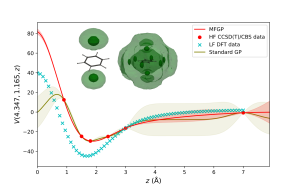
  • S. Akram, S. Paul, C. Kovacs, Vasileios Maroulas, Adrian Del Maestro, and Konstantinos D. Vogiatzis. “Accurate helium–benzene potential: From CCSD(T) to Gaussian process regression.” Journal of Chemical Physics 164, 114108 (2026). DOI: https://doi.org/10.1063/5.0322444
    Insert figure here

    Comparison of helium density patterns around benzene.

    How this connects to CAMM

    This paper develops a highly accurate model of the helium–benzene interaction, a prototype for understanding helium behavior near graphene-like materials. By using Gaussian process regression to improve simulations of low-dimensional quantum phenomena, the work contributes to IRG 1’s focus on data-driven approaches for quantum materials.

  • X. Wu, X. Hao, Z. Chen, Y. Cai, M. Wu, C. Chen, K. Wang, F. Ming, Steven Johnston, Rui-Xing Zhang, and Hanno H. Weitering. “Microscopic Fingerprint of Chiral Superconductivity.” Physical Review X 16, 011026 (2026). DOI: https://doi.org/10.1103/jmmf-mpr8

    Insert figure here

    Quasiparticle interference maps around an atomic defect.

    How this connects to CAMM

    This paper demonstrates real-space signatures of chiral superconductivity in a single atomic layer of tin on silicon. By using quasiparticle interference imaging to identify nodal and antinodal patterns bound to atomic defects, the work contributes to IRG 1’s focus on microscopic signatures of quantum materials.

  • G. Zu, N. Mao, C. Felser, and Yang Zhang. “Interpretation of Crystal Energy Landscapes with Kolmogorov–Arnold Networks.” Nano Letters 26, 5036 (2026). DOI: https://doi.org/10.1021/acs.nanolett.6c00039
    Insert figure here

    Periodic-table maps of learned chemical trends.

    How this connects to CAMM

    This paper introduces Kolmogorov–Arnold Networks as an interpretable machine-learning framework for predicting crystalline properties including formation energy, band gap, and work function. By revealing chemical trends connected to periodic-table patterns and quantum mechanical principles, the work contributes to IRG 1’s focus on transparent, data-driven materials discovery.

  • J. Xie, Wonhee Ko, Rui-Xing Zhang, and B. Yao. “Physics-guided deep learning with adversarial domain adaptation: Applications to STM image denoising.” Journal of Applied Physics 139, 144303 (2026). DOI: https://doi.org/10.1063/5.0316661
    Insert figure here

    Input scanning tunneling microscopy images compared with PDA-Net denoising results.

    How this connects to CAMM

    This paper introduces PDA-Net, a physics-guided deep learning framework for denoising scanning tunneling microscopy (STM) images without paired clean and noisy experimental data. By using simulated STM images and adversarial domain adaptation to improve real STM image quality, the work contributes to IRG 1’s focus on data-driven tools for interpreting quantum material properties.

  • J. Tang, T. S. Ding, S. Ding, J. Li, C. Yi, T. Tang, Z. Huang, X. Wu, Z. Huang, B. Singh, T. Qian, V. Belosevich, M. Guo, A. Gao, N. Peshcherenko, Z. Sun, M. Shehabeldin, K. Watanabe, T. Taniguchi, A. N. Pasupathy, C. Felser, K. S. Burch, N. Ni, Y. Wang, Yang Zhang, S.-Y. Xu, and Q. Ma. “Bistable superlattice switching in a quantum spin Hall insulator.” Nature 652, 68 (2026). DOI: https://doi.org/10.1038/s41586-026-10309-w
    Insert figure here

    Schematic of superlattice switching in monolayer TaIrTe4.

    How this connects to CAMM

    This paper reports bistable superlattice switching in monolayer TaIrTe4, a dual quantum spin Hall insulator, where electrostatic tuning reversibly switches the system between two lattice configurations with sharply different periodicities. By linking electronic and lattice instabilities through transport measurements, Raman spectroscopy, and scanning tunnelling microscopy, the work contributes to IRG 1’s focus on quantum materials and emergent electronic behavior.

  • J. O. Agada and Arpan Biswas. “LLMs, RAG systems, and agents in crystalline materials discovery and characterization: A systematic review.” MRS Bulletin 1557 (2026). DOI: https://doi.org/10.1557/s43577-026-01057-3
    Insert figure here

    Large language model and retrieval-augmented generation workflows for materials discovery.

    How this connects to CAMM

    This review examines how large language models (LLMs), retrieval-augmented generation (RAG), and agent-based artificial intelligence systems can support crystalline materials discovery through literature mining, database integration, structure prediction, defect analysis, and multimodal reasoning. The work contributes to IRG 1’s focus on trustworthy AI-enabled tools for accelerating materials discovery.

IRG 2

  • V. Chawla, Dayakar Penumadu, and Sergei V. Kalinin. “Automation of nanoindentation targeting control using machine vision.” Review of Scientific Instruments 97, 043901 (2026). DOI: https://doi.org/10.1063/5.0307893
    Insert figure here

    High-accuracy nanoindentation workflow using reference-indent alignment.

    How this connects to CAMM

    This paper presents an automated nanoindentation framework that uses machine vision to target specific microstructural features more precisely than traditional grid-based workflows. By linking image-based feature recognition with Python-based instrument control, the work contributes to IRG 2’s focus on AI-enabled characterization and autonomous experimentation workflows for advanced materials.

  • G. Adamson, J. M. Hirtz, C. Overstreet, E. O’Quinn, C. Kinsler-Fedon, P. Simon, C. Park, X. Wang, T. Liang, Haixuan Xu, V. Keppens, Katharine Page, and Maik Lang. “Influence of Compositional Complexity on Amorphization Resistance of Swift Heavy Ion Irradiated Titanate Pyrochlores.” Inorganic Chemistry 65, 280–290 (2026). DOI: https://doi.org/10.1021/acs.inorgchem.5c04254
    Insert figure here

    Ion-track damage and structural disorder in a compositionally complex titanate pyrochlore.

    How this connects to CAMM

    This paper examines how compositional complexity affects the radiation response of titanate pyrochlore oxides exposed to swift heavy ion irradiation. By comparing structural changes using synchrotron X-ray diffraction, transmission electron microscopy (TEM), Raman spectroscopy, and density functional theory (DFT), the work contributes to IRG 2’s focus on understanding and designing materials for extreme environments.

  • Y. Liu and Sergei V. Kalinin. “Pareto-Optimal Experimentation: Human-Guided Multi-Objective Bayesian Optimization in Scanning Probe Microscopy.” Nano Letters 26, 441–447 (2026). DOI: https://doi.org/10.1021/acs.nanolett.5c05373
    Insert figure here

    Pareto-optimal trade-offs between probe safety and scan quality.

    How this connects to CAMM

    This paper presents multi-objective Bayesian optimization as a framework for autonomous scanning probe microscopy (SPM) when several experimental goals must be balanced at once. By using Pareto fronts and human guidance to manage trade-offs such as probe safety and scan quality, the work contributes to IRG 2’s focus on AI-enabled characterization and autonomous experimentation workflows for advanced materials.

  • A. T. Wood, S. Puplampu, K. McNulty, B. H. Jared, S. Babu, and Dayakar Penumadu. “Validation of Profilometry-based Indentation Plastometry (PIP) testing for rapid qualification of Electron Beam-Powder-Bed Fusion (EB-PBF) with Ti–6Al–4V builds.” Advanced Engineering Materials e202502047 (2026). DOI: https://doi.org/10.1002/adem.202502047

    How this connects to CAMM

    This paper validates profilometry-based indentation plastometry as a faster method for evaluating mechanical properties in Ti–6Al–4V components made by electron beam-powder bed fusion. By connecting rapid mechanical testing with multiscale characterization and high-temperature property measurements, the work contributes to IRG 2’s focus on efficient qualification of advanced materials for demanding manufacturing and extreme-environment applications.

  • M. D. Hossain, N. S. McIlwaine, N. O. Marquez-Rios, A. C. Feltrin, V. Chawla, R. A. Mayonovic, W. G. Fahrenholtz, Dayakar Penumadu, E. Zurek, D. W. Brenner, D. E. Wolfe, S. Divilov, H. Eckert, S. Curtarolo, and J.-P. Maria. “Superhard refractory high-entropy diborides.” Physical Review Materials 10, 033604 (2026). DOI: https://doi.org/10.1103/hqlp-dcvl
    Insert figure here

    Hardness of high-entropy diborides as a function of valence electron concentration.

    How this connects to CAMM

    This paper shows that valence electron concentration (VEC) can be used to predict bonding and hardness in high-entropy diborides, identifying a VEC of 10.0 per formula unit as the point where these materials become superhard. By combining first-principles calculations with experimental synthesis and mechanical characterization, the work contributes to IRG 2’s focus on designing advanced ceramics with strong thermomechanical performance for extreme environments.

  • J. Marshall, S. L. Sanchez, R. Desai, E. Foadian, U. Pratiush, A. Mannodi-Kanakkithodi, Sergei V. Kalinin, and Mahshid Ahmadi. “POLARIS: perovskite optimization using LLM-assisted refinement and intelligent screening.” Digital Discovery 5, 1765–1782 (2026). DOI: https://doi.org/10.1039/D5DD00378D
    Insert figure here

    Large-language-model-assisted data mining and deep-kernel learning workflow for perovskite spacer discovery.

    How this connects to CAMM

    This paper presents POLARIS, a reproducible pipeline that combines literature mining, large language model (LLM)-assisted data extraction, molecular graph generation, and uncertainty-aware predictive modeling to identify organic spacer cations for two-dimensional halide perovskites. By turning fragmented literature into structured, actionable design data, the work contributes to IRG 2’s focus on AI-enabled materials discovery and screening workflows for advanced functional materials.

Back to publication years

2025

IRG 1

  • M. Thamm, H. Radhakrishnan, H. Barghathi, C. M. Herdman, Arpan Biswas, B. Rosenow, and Adrian Del Maestro. “Berezinskii-Kosterlitz-Thouless Renormalization Group Flow at a Quantum Phase Transition.” Physical Review Letters 135, 116002 (2025). DOI: https://doi.org/10.1103/4xdz-5vq7
    Insert image here

    Scaling analysis used to identify the critical interaction strength for the Berezinskii-Kosterlitz-Thouless transition.

    How this connects to CAMM

    This paper studies the Berezinskii-Kosterlitz-Thouless (BKT) transition in the one-dimensional Bose-Hubbard model, a benchmark system for low-dimensional quantum physics. By combining numerical simulations, finite-size scaling, and Bayesian analysis, the work resolves earlier challenges in identifying the transition’s universal scaling behavior. This supports IRG 1’s focus on computational and data-driven approaches to quantum phase transitions and emergent behavior in quantum materials.

  • P. Park, W. Cho, C. Kim, Y. An, K. Iida, R. Kajimoto, S. Matin, S.-S. Zhang, Cristian D. Batista, and J.-G. Park. “Spin Dynamics of Triple-q Magnetic Orderings in a Triangular Lattice: Implications for Multi-Q Orderings in General Two-Dimensional Lattices.” Physical Review X 15, 031032 (2025). DOI: https://doi.org/10.1103/y9ly-4kld
    Insert image here

    Comparison of single-Q and triple-Q magnetic ordering and their long-wavelength magnon profiles on a triangular lattice.

    How this connects to CAMM

    This paper studies how spin dynamics can distinguish topological triple-Q magnetic order from more conventional single- or double-Q magnetic order in two-dimensional triangular lattice systems. Using the triangular-lattice antiferromagnet Co0.325TaS2, the authors combine inelastic neutron scattering with spin dynamics simulations to show that the Goldstone-mode velocities are strongly anisotropic in the single-Q phase but nearly isotropic in the triple-Q phase. This supports IRG 1’s focus on quantum materials by providing a diagnostic tool for identifying topological magnetic order and understanding emergent spin behavior in two-dimensional materials.

  • H. Zhao, R. Millan-Solsona, M. Checa, S. R. Brown, J. L. Morrell-Falvey, L. Collins, and Arpan Biswas. “A bi-channel aided stitching of atomic force microscopy images.” Scientific Reports 15, 41897 (2025). DOI: https://doi.org/10.1038/s41598-025-25855-y
    Insert image here

    Bi-channel aided stitching workflow for improving atomic force microscopy image alignment.

    How this connects to CAMM

    This paper presents a bi-channel image stitching method for atomic force microscopy (AFM) data, where limited field-of-view can make it difficult to combine multiple images accurately. Instead of relying only on the topographical image, the workflow uses amplitude and phase channels to improve feature matching and estimate how image tiles should be aligned. This supports IRG 1’s focus on data-driven materials characterization by improving microscopy image processing and helping researchers avoid errors in downstream analysis.

  • B. Venkatesan, S.-Y. Guan, J.-T. Chang, S.-B. Chiu, P.-Y. Yang, C.-C. Su, T.-R. Chang, K. Raju, R. Sankar, S. Fongchaiya, M.-W. Chu, C.-S. Chang, G. Chang, H. Lin, Adrian Del Maestro, Y.-J. Kao, and T.-M. Chuang. “Direct visualization of a disorder driven electronic smectic phase in nonsymmorphic square-net semimetal GdSbTe.” npj Quantum Materials 10, 56 (2025). DOI: https://doi.org/10.1038/s41535-025-00779-y
    Insert image here

    Scanning tunneling microscopy images showing electronic liquid crystal phases in GdSbTe.

    How this connects to CAMM

    This paper reports the direct visualization of an electronic smectic phase in the nonsymmorphic square-net semimetal GdSbTe. Using spectroscopic imaging–scanning tunneling microscopy, the authors identify incommensurate smectic charge modulation and local unidirectional nanostructures that coexist with Dirac fermions. This supports IRG 1’s focus on quantum materials by showing how disorder, electronic symmetry breaking, and correlated behavior can emerge in a weakly correlated material platform.

  • Y. Choi, S. Lee, D. Shin, S. Sim, M. Jung, D. Wulferding, M. Kim, J. Eom, M. Mostafa, Wonhee Ko, S. Cha, J. Hwang, H. Y. Jeong, K. K. Kim, and W. S. Choi. “Universal Fabrication of Graphene/Perovskite Oxide Hybrid Heterostructures.” Small Structures 202500613 (2025). DOI: https://doi.org/10.1002/sstr.202500613
    Insert image here

    Microscopy images showing monolayer graphene grown directly on perovskite oxide substrates.

    How this connects to CAMM

    This paper presents a transfer-free method for directly growing graphene on insulating perovskite oxide substrates, avoiding the defects and complexity that can come from transferring graphene grown on metals. Using atmospheric chemical vapor deposition, the authors demonstrate uniform monolayer graphene growth on several oxide substrates and show that growth temperature is critical for controlling graphene quality. This supports IRG 1’s focus on quantum and functional materials by advancing reproducible fabrication routes for graphene/perovskite oxide heterostructures and enabling studies of interfacial electronic and phonon coupling.

  • C. Farhang, W. R. Meier, W. Lu, J. Li, Y. Wu, S. Mozaffari, R. P. Madhogaria, Yang Zhang, David Mandrus, and J. Xia. “Discovery of an intermediate nematic state in a bilayer kagome metal ScV6Sn6.” Nature Communications 16, 1038 (2025). DOI: https://doi.org/10.1038/s41467-025-63294-5
    Insert image here

    Thermodynamic, transport, and optical signatures of an intermediate nematic phase in ScV6Sn6.

    How this connects to CAMM

    This paper reports an intermediate nematic phase in the bilayer kagome metal ScV6Sn6, appearing below the charge density wave transition. The authors use thermodynamic, transport, optical, and Sagnac interferometry measurements to show that the phase breaks in-plane rotational symmetry without spontaneous time-reversal-symmetry breaking. This supports IRG 1’s focus on quantum materials by highlighting how charge density competition, kagome physics, and electronic symmetry breaking can produce complex emergent phases.

  • T. Xi, H. Jiang, J. Li, Y. He, Y. Gu, C. Fox, L. Primeau, Y. Mao, J. Rollins, T. Taniguchi, K. Watanabe, D. van der Weide, D. Rhodes, Yang Zhang, Y. Wang, and J. Xiao. “Terahertz sensing based on the nonlinear electrodynamics of the two-dimensional correlated topological semimetal TaIrTe4.” Nature Electronics 8, 578–586 (2025). DOI: https://doi.org/10.1038/s41928-025-01397-z
    Insert image here

    Room-temperature terahertz rectification and broadband detector response in few-layer TaIrTe4.

    How this connects to CAMM

    This paper demonstrates a terahertz detector based on the nonlinear electrodynamics of two-dimensional tantalum iridium telluride (TaIrTe4), a correlated topological semimetal. The authors show that TaIrTe4 can sense terahertz radiation at room temperature with high sensitivity, broadband response, zero-bias operation, and ultrafast intrinsic response times. This supports IRG 1’s focus on quantum and topological materials by showing how nonlinear electronic behavior in a two-dimensional material can enable next-generation sensing technologies.

  • M. M. Bermudez, R. A. Borzi, Alan Tennant, and S. A. Grigera. “Low-temperature state of the spin-ice material: Reverse Monte Carlo investigation.” Physical Review B 112, 094431 (2025). DOI: https://doi.org/10.1103/8xtq-tfx3
    Insert image here

    Diffuse neutron scattering and reverse Monte Carlo analysis of the low-temperature spin-ice state.

    How this connects to CAMM

    This paper investigates the low-temperature magnetic state of the spin-ice material Dy2Ti2O7, where neutron scattering experiments show diffuse patterns rather than the sharp Bragg peaks expected for a fully ordered ground state. Using a reverse Monte Carlo approach, the authors identify compatible spin configurations and examine whether short-range antiferromagnetic spin chains can help explain the observed correlations. This supports IRG 1’s focus on quantum and correlated materials by using computational analysis to interpret complex magnetic behavior in frustrated spin systems.

  • Arpan Biswas, R. Vasudevan, R. Pant, I. Takeuchi, H. Funakubo, and Y. Liu. “SANE: Strategic autonomous non-smooth exploration for multiple optima discovery in multi-modal and non-differentiable black-box functions.” Digital Discovery 4, 853–867 (2025). DOI: https://doi.org/10.1039/d4dd00299g
    Insert image here

    Strategic autonomous non-smooth exploration workflow for discovering multiple optima in complex search spaces.

    How this connects to CAMM

    This publication reports an autonomous Bayesian optimization algorithm designed for rapid searches in spaces with highly nonlinear or discontinuous objective functions. The work supports IRG 1’s long-term automation vision and advances artificial intelligence/machine learning methods relevant to future automated scanning tunneling spectroscopy measurements.

  • R. Bulanadi, J. Chowdhury, H. Funakubo, M. Ziatdinov, R. Vasudevan, Arpan Biswas, and Y. Liu. “Beyond Optimization: Exploring Novelty Discovery in Autonomous Experiments.” ACS Nanoscience Au 6, 86–94 (2025). DOI: https://doi.org/10.1021/acsnanoscienceau.5c00106
    Insert figure here

    Autonomous microscopy workflow for novelty discovery beyond standard optimization.

    How this connects to CAMM

    This paper introduces INS2ANE, an autonomous microscopy framework designed to discover novel phenomena rather than only optimize a predefined target. By combining novelty scoring with strategic exploration of under-sampled regions, the work contributes to IRG 1’s focus on artificial intelligence-guided experimentation and discovery in complex materials systems.

  • J. Tang, T. S. Ding, C. Wang, N. Mao, V. Belosevich, Yang Zhang, X. Qian, and Q. Ma. “Quantum spin Hall effects in van der Waals materials.” Advanced Quantum Technologies 8, e00327 (2025). DOI: https://doi.org/10.1002/qute.202500327

    How this connects to CAMM

    This review examines quantum spin Hall effects in van der Waals materials, where exposed surfaces, mechanical stacking, and moiré engineering create new opportunities to study topology, spin–orbit coupling, electronic interactions, and correlated quantum states. The paper highlights material families such as WTe2 and TaIrTe4, along with related phases including charge density waves, superconductivity, nonlinear Hall responses, and quantum anomalous Hall states. This supports IRG 1’s focus on quantum materials by connecting two-dimensional topological systems with emergent electronic behavior and possible future device applications.

  • M. Naamneh, E. C. O’Quinn, E. Paris, D. McNally, Y. Tseng, W. R. Pudelko, D. J. Gawryluk, J. Shamblin, B. Cohen-Stead, M. Shi, M. Radovic, Maik Lang, T. Schmitt, Steven Johnston, and N. C. Plumb. “Persistence of small polarons into the superconducting doping range of Ba1−xKxBiO3.” Physical Review Research 7, 043082 (2025). DOI: https://doi.org/10.1103/s3p1-cy1s
    Insert image here

    Local lattice distortions and electron–phonon coupling in doped Ba1−xKxBiO3.

    How this connects to CAMM

    This paper investigates how small polarons persist into the superconducting doping range of Ba1−xKxBiO3. By combining resonant inelastic X-ray scattering, neutron total scattering, and modeling, the authors show that short-range breathing distortions and strong electron–phonon coupling remain present in the superconducting regime. This supports CAMM’s broader materials discovery goals by connecting local lattice distortions, electron–phonon interactions, and superconducting behavior.

  • P. Siwakoti, D. Gong, S. Pandey, J. Li, L. Primeau, U. Lamichhane, B. R. Sankhi, Y. Xin, E. Karapetrova, J. Strempfer, Y. Choi, Yang Zhang, D. Meyers, and J. Liu. “Enhancing anomalous Hall effect with suppressed ferromagnetism in the SrTiO3-confined bilayer heterostructure of ultrathin SrRuO3 and SrIrO3.” Applied Materials Today 47, 102960 (2025). DOI: https://doi.org/10.1016/j.apmt.2025.102960
    Insert image here

    SrTiO3-confined SrRuO3/SrIrO3 bilayer heterostructure for enhancing anomalous Hall response.

    How this connects to CAMM

    This paper studies a confined bilayer heterostructure made from ultrathin SrRuO3 and SrIrO3 separated by SrTiO3 spacers. The authors show that the anomalous Hall effect can be enhanced even as ferromagnetism and perpendicular magnetic anisotropy are suppressed, with the behavior attributed to interfacial Ru–Ir hybridization near the Fermi level. This supports CAMM’s broader materials discovery goals by showing how interface design can tune spin–orbit-coupled transport properties for future oxide spintronics.

  • H. Jiang, T. Xi, J. Li, Y. He, H. Ma, Y. Mao, T. Taniguchi, K. Watanabe, D. A. Rhodes, Yang Zhang, J. Xiao, and Y. Wang. “Probing interplay of topological properties and electron correlation in TaIrTe4 via nonlinear Hall effect.” Nature Communications 16, 6351 (2025). DOI: https://doi.org/10.1038/s41467-025-61347-3
    Insert image here

    Nonlinear Hall measurements revealing a correlated state in few-layer TaIrTe4.

    How this connects to CAMM

    This paper uses nonlinear Hall measurements to probe the relationship between topology and electron correlation in few-layer TaIrTe4. The authors report the emergence of a correlated state below a critical temperature and bias current, with ultra-large nonlinear conductivity attributed to charge-density-wave formation and Berry curvature redistribution. This supports CAMM’s broader materials discovery goals by showing how electronic correlations can reshape nonlinear transport responses in two-dimensional systems.

  • D. Kalita, K. Mulewska, I. Jóźwik, Y. Zhang, Ł. Kurpaska, Philip D. Rack, W. J. Weber, and J. Jagielski. “Effect of Zr Addition on the Structure, Nanomechanical Properties, and Helium Irradiation Behavior of the Novel MoTaTiV Body-Centered Cubic Concentrated Solid Solution Alloy.” Journal of Nuclear Materials 615, 155994 (2025). DOI: https://doi.org/10.1016/j.jnucmat.2025.155994
    Insert image here

    Effects of zirconium addition and helium irradiation on MoTaTiV-based concentrated solid solution alloys.

    How this connects to CAMM

    This paper investigates how adding zirconium changes the structure, nanomechanical properties, and helium irradiation behavior of a MoTaTiV body-centered cubic concentrated solid solution alloy. The study reports that zirconium addition forms a quinary MoTaTiVZr alloy with increased lattice distortion and examines how helium bubbles develop after ion irradiation. This supports CAMM’s broader materials discovery goals by connecting alloy composition, mechanical response, and irradiation damage behavior in refractory concentrated solid solution alloys.

  • D. Kalita, A. Esfandiarpour, I. Jóźwik, Y. Zhang, J. Byggmästar, M. J. Alava, Ł. Kurpaska, W. J. Weber, Philip D. Rack, and J. Jagielski. “High temperature He bubble evolution and thermal stability of the WTaCrV refractory concentrated solid solution alloy.” Materials & Design 252, 113751 (2025). DOI: https://doi.org/10.1016/j.matdes.2025.113751
    Insert image here

    In situ transmission electron microscopy tracking helium bubble evolution in a WTaCrV refractory concentrated solid solution alloy.

    How this connects to CAMM

    This work investigates the thermal stability and high-temperature evolution of helium bubbles in a WTaCrV refractory concentrated solid solution alloy designed for nuclear fusion applications. After helium-ion irradiation, the authors use in situ heating in a transmission electron microscope over 700 °C to 1000 °C to follow how nanometric helium bubbles evolve. This supports CAMM’s broader materials discovery goals by connecting irradiation damage, high-temperature stability, and microstructural evolution in refractory compositionally complex alloys.

  • R. Emery, S. B. Puplampu, A. Wood, Dayakar Penumadu, Eric Lass, J. Lasseter, K. A. Unocic, S. Chen, Y. Zhao, Steve Zinkle, T. Liang, Haixuan Xu, D. A. Gilbert, C. C. Buchanan, P. K. Liaw, and Philip D. Rack. “Thin film combinatorial sputtering of TaTiHfZr refractory compositionally complex alloys for rapid materials discovery.” Materials & Design 250, 113643 (2025). DOI: https://doi.org/10.1016/j.matdes.2025.113643
    Insert image here

    Combinatorial thin-film synthesis and property mapping of TaTiHfZr refractory compositionally complex alloys.

    How this connects to CAMM

    This paper uses thin-film combinatorial sputtering to rapidly explore mechanical and thermal properties across TaTiHfZr refractory compositionally complex alloy compositions. Guided by atomistic and thermodynamic calculations, the study maps a broad alloy space and identifies transformation-induced plasticity linked to a stress-induced phase transformation in the nanogranular microstructure. This supports CAMM’s broader materials discovery goals by connecting high-throughput synthesis, property mapping, and scalable materials design.

  • Y. Mu, J. Liang, Z. Xi, J. Li, Y. Zhou, L. Shi, L. Lei, S. Yang, and X. Sun. “Compositional gradient-driven design of additively manufactured nickel-based superalloys for enhanced 900°C strength-ductility synergy via Ti/Al optimization.” Materials Today Communications 49, 113751 (2025). DOI: https://doi.org/10.1016/j.mtcomm.2025.113751
    Insert image here

    Composition-gradient additive manufacturing approach for optimizing Ti/Al content in nickel-based superalloys.

    How this connects to CAMM

    This paper uses additive manufacturing to create nickel-based superalloys with tailored titanium/aluminum compositional gradients and study how composition affects microstructure and high-temperature mechanical properties. The work focuses on improving the strength–ductility balance at 900 °C through Ti/Al optimization. This supports CAMM’s broader materials discovery goals by showing how compositionally graded manufacturing can accelerate alloy design for high-temperature performance.

IRG 2

  • A. Raghavan, U. Pratiush, M. Valleti, R. Liu, R. Emery, H. Funakubo, Y. Liu, Philip D. Rack, and Sergei Kalinin. “Invariant discovery of features across multiple length scales: Applications in microscopy and autonomous materials characterization.” Journal of Applied Physics 137, 034901 (2025). DOI: https://doi.org/10.1063/5.0233070
    Insert image here

    Scale-invariant variational autoencoder workflow for discovering image features across multiple length scales.

    How this connects to CAMM

    This paper introduces a scale-invariant variational autoencoder approach for identifying meaningful features in image data across multiple length scales. The method is demonstrated on ferroelectric domain images, electron-beam-induced phenomena in graphene, and topography evolution across combinatorial libraries. This supports IRG 2’s focus on autonomous materials characterization by helping extract structure-relevant information from microscopy data and initialize decision-making for automated experiments and structure–property discovery.

  • Y. Liu, R. Proksch, J. Bemis, U. Pratiush, A. Dubey, Mahshid Ahmadi, R. Emery, Philip D. Rack, Y.-C. Liu, J.-C. Yang, and Sergei V. Kalinin. “Machine Learning-Based Reward-Driven Tuning of Scanning Probe Microscopy: Toward Fully Automated Microscopy.” ACS Nano 19, 19659–19669 (2025). DOI: https://doi.org/10.1021/acsnano.4c18760
    Insert image here

    Reward-driven workflow for automated tuning of tapping-mode scanning probe microscopy.

    How this connects to CAMM

    This paper presents a reward-driven workflow for automating tapping-mode scanning probe microscopy (SPM), a widely used imaging method that is often difficult to optimize manually. The reward function combines multiple image channels with physical and empirical knowledge of high-quality scans, allowing the system to select scanning parameters that improve image consistency while reducing operator time, probe damage, and sample damage. This supports IRG 2’s focus on autonomous characterization and artificial intelligence-enabled microscopy workflows for reliable materials imaging.

  • B. N. Slautin, Y. Liu, J. Dec, V. V. Shvartsman, D. C. Lupascu, M. A. Ziatdinov, and Sergei V. Kalinin. “Measurements with noise: Bayesian optimization for co-optimizing noise and property discovery in automated experiments.” Digital Discovery 4, 1066–1074 (2025). DOI: https://doi.org/10.1039/d4dd00391h
    Insert image here

    Bayesian optimization workflow for balancing measurement noise, experiment time, and property discovery.

    How this connects to CAMM

    This paper develops a Bayesian optimization workflow that considers both the target material property and the measurement noise during automated experiments. By treating measurement time as an input parameter, the workflow balances signal quality, experimental duration, and resource use. The method is validated through simulations and piezoresponse force microscopy experiments, supporting IRG 2’s focus on autonomous materials characterization and efficient artificial intelligence-guided experimental workflows.

  • B. N. Slautin, Y. Liu, K. Barakati, Y. Liu, R. Emery, S. Hong, A. Dubey, V. V. Shvartsman, D. C. Lupascu, S. L. Sanchez, Mahshid Ahmadi, Y. Kim, E. Strelcov, K. A. Brown, Philip D. Rack, and Sergei V. Kalinin. “Materials discovery in combinatorial and high-throughput synthesis and processing: A new frontier for SPM.” Applied Physics Reviews 12, 031321 (2025). DOI: https://doi.org/10.1063/5.0259851
    Insert image here

    How this connects to CAMM

    This review connects scanning probe microscopy (SPM), combinatorial synthesis, and high-throughput materials processing as tools for accelerated materials discovery. The work supports IRG 2’s focus on autonomous and artificial intelligence-enabled characterization workflows for complex materials.

  • Mahshid Ahmadi and Sergei V. Kalinin. “Learning the flow from the get-go.” Nature Chemical Engineering 2, 472–473 (2025). DOI: https://doi.org/10.1038/s44286-025-00261-3
    Insert image here

    How this connects to CAMM

    This publication discusses machine-learning-enabled approaches for learning experimental flow and improving automated materials workflows. Because it includes Sergei V. Kalinin and supports artificial intelligence-enabled materials characterization and automation, it is grouped under IRG 2.

  • U. Pratiush, Sergei Kalinin, et al. “Scientific exploration with expert knowledge (SEEK) in autonomous scanning probe microscopy with active learning.” Digital Discovery 4, Jan. 2025. DOI: https://doi.org/10.1039/D4DD00277F
    Insert image here

    How this connects to CAMM

    This work extends autonomous experimentation in scanning probe microscopy (SPM) by incorporating prior knowledge and human interest into deep-kernel-learning workflows. These methods are directly relevant to IRG 2 characterization efforts and support more effective autonomous materials exploration.

  • J. Li and Haixuan Xu. “Dislocation properties in BCC refractory compositionally complex alloys from atomistic simulations.” Computational Materials Science 253, 113859 (2025). DOI: https://doi.org/10.1016/j.commatsci.2025.113859
    Insert image here

    How this connects to CAMM

    This publication uses density functional theory (DFT) and machine-learned interatomic potentials to study dislocation behavior in body-centered cubic refractory compositionally complex alloys. The results provide guidance for IRG 2 alloy design within refractory compositionally complex alloy spaces.

  • M. Naamneh, E. C. O’Quinn, E. Paris, D. McNally, Y. Tseng, W. R. Pudelko, D. J. Gawryluk, J. Shamblin, B. Cohen-Stead, M. Shi, M. Radovic, Maik Lang, T. Schmitt, Steven Johnston, and N. C. Plumb. “Persistence of small polarons into the superconducting doping range of Ba1−xKxBiO3.” Physical Review Research 7, 043082 (2025). DOI: https://doi.org/10.1103/s3p1-cy1s
    Insert image here

    Local lattice distortions and electron–phonon coupling in doped Ba1−xKxBiO3.

    How this connects to CAMM

    This paper investigates how small polarons persist into the superconducting doping range of Ba1−xKxBiO3. By combining resonant inelastic X-ray scattering, neutron total scattering, and modeling, the authors show that short-range breathing distortions and strong electron–phonon coupling remain present in the superconducting regime. This supports CAMM’s broader materials discovery goals by connecting local lattice distortions, electron–phonon interactions, and superconducting behavior.

  • P. Siwakoti, D. Gong, S. Pandey, J. Li, L. Primeau, U. Lamichhane, B. R. Sankhi, Y. Xin, E. Karapetrova, J. Strempfer, Y. Choi, Yang Zhang, D. Meyers, and J. Liu. “Enhancing anomalous Hall effect with suppressed ferromagnetism in the SrTiO3-confined bilayer heterostructure of ultrathin SrRuO3 and SrIrO3.” Applied Materials Today 47, 102960 (2025). DOI: https://doi.org/10.1016/j.apmt.2025.102960
    Insert image here

    SrTiO3-confined SrRuO3/SrIrO3 bilayer heterostructure for enhancing anomalous Hall response.

    How this connects to CAMM

    This paper studies a confined bilayer heterostructure made from ultrathin SrRuO3 and SrIrO3 separated by SrTiO3 spacers. The authors show that the anomalous Hall effect can be enhanced even as ferromagnetism and perpendicular magnetic anisotropy are suppressed, with the behavior attributed to interfacial Ru–Ir hybridization near the Fermi level. This supports CAMM’s broader materials discovery goals by showing how interface design can tune spin–orbit-coupled transport properties for future oxide spintronics.

  • H. Jiang, T. Xi, J. Li, Y. He, H. Ma, Y. Mao, T. Taniguchi, K. Watanabe, D. A. Rhodes, Yang Zhang, J. Xiao, and Y. Wang. “Probing interplay of topological properties and electron correlation in TaIrTe4 via nonlinear Hall effect.” Nature Communications 16, 6351 (2025). DOI: https://doi.org/10.1038/s41467-025-61347-3
    Insert image here

    Nonlinear Hall measurements revealing a correlated state in few-layer TaIrTe4.

    How this connects to CAMM

    This paper uses nonlinear Hall measurements to probe the relationship between topology and electron correlation in few-layer TaIrTe4. The authors report the emergence of a correlated state below a critical temperature and bias current, with ultra-large nonlinear conductivity attributed to charge-density-wave formation and Berry curvature redistribution. This supports CAMM’s broader materials discovery goals by showing how electronic correlations can reshape nonlinear transport responses in two-dimensional systems.

  • D. Kalita, K. Mulewska, I. Jóźwik, Y. Zhang, Ł. Kurpaska, Philip D. Rack, W. J. Weber, and J. Jagielski. “Effect of Zr Addition on the Structure, Nanomechanical Properties, and Helium Irradiation Behavior of the Novel MoTaTiV Body-Centered Cubic Concentrated Solid Solution Alloy.” Journal of Nuclear Materials 615, 155994 (2025). DOI: https://doi.org/10.1016/j.jnucmat.2025.155994
    Insert image here

    Effects of zirconium addition and helium irradiation on MoTaTiV-based concentrated solid solution alloys.

    How this connects to CAMM

    This paper investigates how adding zirconium changes the structure, nanomechanical properties, and helium irradiation behavior of a MoTaTiV body-centered cubic concentrated solid solution alloy. The study reports that zirconium addition forms a quinary MoTaTiVZr alloy with increased lattice distortion and examines how helium bubbles develop after ion irradiation. This supports CAMM’s broader materials discovery goals by connecting alloy composition, mechanical response, and irradiation damage behavior in refractory concentrated solid solution alloys.

  • D. Kalita, A. Esfandiarpour, I. Jóźwik, Y. Zhang, J. Byggmästar, M. J. Alava, Ł. Kurpaska, W. J. Weber, Philip D. Rack, and J. Jagielski. “High temperature He bubble evolution and thermal stability of the WTaCrV refractory concentrated solid solution alloy.” Materials & Design 252, 113751 (2025). DOI: https://doi.org/10.1016/j.matdes.2025.113751
    Insert image here

    In situ transmission electron microscopy tracking helium bubble evolution in a WTaCrV refractory concentrated solid solution alloy.

    How this connects to CAMM

    This work investigates the thermal stability and high-temperature evolution of helium bubbles in a WTaCrV refractory concentrated solid solution alloy designed for nuclear fusion applications. After helium-ion irradiation, the authors use in situ heating in a transmission electron microscope over 700 °C to 1000 °C to follow how nanometric helium bubbles evolve. This supports CAMM’s broader materials discovery goals by connecting irradiation damage, high-temperature stability, and microstructural evolution in refractory compositionally complex alloys.

  • R. Emery, S. B. Puplampu, A. Wood, Dayakar Penumadu, Eric Lass, J. Lasseter, K. A. Unocic, S. Chen, Y. Zhao, Steve Zinkle, T. Liang, Haixuan Xu, D. A. Gilbert, C. C. Buchanan, P. K. Liaw, and Philip D. Rack. “Thin film combinatorial sputtering of TaTiHfZr refractory compositionally complex alloys for rapid materials discovery.” Materials & Design 250, 113643 (2025). DOI: https://doi.org/10.1016/j.matdes.2025.113643
    Insert image here

    Combinatorial thin-film synthesis and property mapping of TaTiHfZr refractory compositionally complex alloys.

    How this connects to CAMM

    This paper uses thin-film combinatorial sputtering to rapidly explore mechanical and thermal properties across TaTiHfZr refractory compositionally complex alloy compositions. Guided by atomistic and thermodynamic calculations, the study maps a broad alloy space and identifies transformation-induced plasticity linked to a stress-induced phase transformation in the nanogranular microstructure. This supports CAMM’s broader materials discovery goals by connecting high-throughput synthesis, property mapping, and scalable materials design.

  • Y. Mu, J. Liang, Z. Xi, J. Li, Y. Zhou, L. Shi, L. Lei, S. Yang, and X. Sun. “Compositional gradient-driven design of additively manufactured nickel-based superalloys for enhanced 900°C strength-ductility synergy via Ti/Al optimization.” Materials Today Communications 49, 113751 (2025). DOI: https://doi.org/10.1016/j.mtcomm.2025.113751
    Insert image here

    Composition-gradient additive manufacturing approach for optimizing Ti/Al content in nickel-based superalloys.

    How this connects to CAMM

    This paper uses additive manufacturing to create nickel-based superalloys with tailored titanium/aluminum compositional gradients and study how composition affects microstructure and high-temperature mechanical properties. The work focuses on improving the strength–ductility balance at 900 °C through Ti/Al optimization. This supports CAMM’s broader materials discovery goals by showing how compositionally graded manufacturing can accelerate alloy design for high-temperature performance.

Back to publication years

2024

IRG 1

  • G. Erwin and Adrian Del Maestro. “Effects of Substrate Corrugation During Helium Adsorption on Graphene in the Grand Canonical Ensemble.” Journal of Low Temperature Physics 215, 525–540 (2024). DOI: https://doi.org/10.1007/s10909-024-03156-4
    Insert image here

    How this connects to CAMM

    This publication reports quantum Monte Carlo simulations of helium adsorbed on graphene and examines how substrate corrugation affects the adsorption potential. The results support IRG 1 by clarifying the level of modeling detail needed to accurately describe interactions between light atoms and two-dimensional materials.

  • Y. Ohno, Adrian Del Maestro, and T. I. Lakoba. “Efficient simulations of Hartree–Fock equations by an accelerated gradient descent method.” Physical Review E 110, 055304 (2024). DOI: https://doi.org/10.1103/PhysRevE.110.055304
    Insert image here

    How this connects to CAMM

    This work reports a new accelerated relaxation method for identifying the ground state of light atoms adsorbed on two-dimensional materials. The method supports IRG 1 goals by enabling more efficient screening of materials relevant to two-dimensional superfluid tunneling barriers.

  • N. Mao, C. Xu, J. Li, T. Bao, P. Liu, Y. Xu, C. Felser, L. Fu, and Yang Zhang. “Transfer learning relaxation, electronic structure, and continuum model for twisted bilayer MoTe2.” Communications Physics 7, Article 262 (2024). DOI: https://doi.org/10.1038/s42005-024-01754-y
    Insert image here

    How this connects to CAMM

    This publication reports a machine-learning-assisted method for large-scale lattice relaxation in moiré materials, using twisted bilayer MoTe2 as a test case. By combining first-principles calculations and transfer learning, the work supports IRG 1 efforts to develop artificial intelligence-enabled methods for predicting and understanding material properties.

  • Y. Shen, L. Primeau, J. Li, T.-D. Nguyen, David Mandrus, Y. C. Lin, and Yang Zhang. “Nonlinear photocurrent in quantum materials for broadband photodetection.” Progress in Quantum Electronics 97, 100535 (2024). DOI: https://doi.org/10.1016/j.pquantelec.2024.100535
    Insert image here

    How this connects to CAMM

    This review highlights advances in nonlinear photocurrents in topological quantum materials and their use in fast, sensitive, broadband photodetection without conventional p–n junctions. The work connects to IRG 1 quantum-device goals and supports future artificial intelligence-guided identification of promising material systems.

  • H. Miao, J. Bouaziz, G. Fabbris, W. R. Meier, F. Z. Yang, H. X. Li, C. Nelson, E. Vescovo, S. Zhang, A. D. Christianson, H. N. Lee, Yang Zhang, Cristian D. Batista, and S. Blügel. “Spontaneous chirality flipping in an orthogonal spin-charge ordered topological magnet.” Physical Review X 14, 011053 (2024). DOI: https://doi.org/10.1103/PhysRevX.14.011053
    Insert image here

    Temperature-driven chirality flipping in the spin-charge ordered topological magnet EuAl4.

    How this connects to CAMM

    This paper reports experimental evidence for spontaneous chirality flipping in the topological magnet EuAl4, where spin density waves and charge density waves are strongly coupled. Using circular dichroism of Bragg peaks in resonant magnetic X-ray scattering, the authors show that the chirality of a helical spin density wave flips through a first-order phase transition as temperature changes. This supports IRG 1’s focus on quantum materials by revealing how spin, charge, lattice, and topological degrees of freedom can combine to produce switchable emergent behavior.

  • C. Xu, J. Li, Y. Xu, Z. Bi, and Yang Zhang. “Maximally localized Wannier functions, interaction models, and fractional quantum anomalous Hall effect in twisted bilayer MoTe2.” Proceedings of the National Academy of Sciences of the United States of America 121, Article e2316749121 (2024). DOI: https://doi.org/10.1073/pnas.2316749121
    Insert image here

    Moiré band modeling and interaction effects in twisted bilayer MoTe2.

    How this connects to CAMM

    This paper develops realistic models for twisted bilayer MoTe2, a moiré quantum material where strong correlations and topology can produce fractional quantum anomalous Hall states. Using large-scale first-principles calculations, maximally localized Wannier functions, and interaction modeling, the authors derive simplified models that capture Coulomb repulsion, correlated hopping, and spin exchange in the top moiré bands. This supports CAMM’s broader materials discovery goals by providing theoretical tools for understanding and predicting correlated topological phases in two-dimensional moiré systems.

  • J. Tang, T. S. Ding, H. Chen, A. Gao, T. Qian, Z. Huang, Z. Sun, X. Han, A. Strasser, J. Li, M. Geiwitz, M. Shehabeldin, V. Belosevich, Z. Wang, Y. Wang, K. Watanabe, T. Taniguchi, D. C. Bell, Z. Wang, L. Fu, Yang Zhang, X. Qian, K. S. Burch, Y. Shi, N. Ni, G. Chang, S.-Y. Xu, and Q. Ma. “Dual quantum spin Hall insulator by density-tuned correlations in TaIrTe4.” Nature 628, 515–521 (2024). DOI: https://doi.org/10.1038/s41586-024-07211-8
    Insert image here

    Density-tuned quantum spin Hall behavior and correlated insulating states in monolayer TaIrTe4.

    How this connects to CAMM

    This paper reports a dual quantum spin Hall insulator in monolayer TaIrTe4, where topology and density-tuned electron correlations combine to produce distinct insulating states. At charge neutrality, the material shows quantum spin Hall behavior with enhanced nonlocal transport and quantized helical edge conductance; with doping, electron correlations drive a second quantum spin Hall state at half filling. This supports CAMM’s broader materials discovery goals by demonstrating how two-dimensional topological materials can host tunable, correlation-driven electronic phases.

IRG 2

  • Y. Liu, U. Pratiush, J. Bemis, R. Proksch, R. Emery, Philip D. Rack, Y.-C. Liu, J.-C. Yang, S. Udovenko, S. Trolier-McKinstry, and Sergei V. Kalinin. “Integration of scanning probe microscope with high-performance computing: Fixed-policy and reward-driven workflows implementation.” Review of Scientific Instruments 95, 093701 (2024). DOI: https://doi.org/10.1063/5.0219990
    Insert image here

    How this connects to CAMM

    This work integrates scanning probe microscopy (SPM) with high-performance computing workflows for fixed-policy and reward-driven microscopy. The publication supports IRG 2’s focus on autonomous characterization, advanced microscopy, and artificial intelligence-enabled experimental control.

  • U. Pratiush, A. Houston, Sergei V. Kalinin, and G. Duscher. “Realizing smart scanning transmission electron microscopy using high performance computing.” Review of Scientific Instruments 95, 103701 (2024). DOI: https://doi.org/10.1063/5.0225401
    Insert image here

    How this connects to CAMM

    This publication reports the integration of machine-learning algorithms into a scanning transmission electron microscopy (STEM) and electron energy loss spectroscopy framework. The autonomous and active-learning approach directly supports IRG 2 characterization goals involving advanced microscopy and high-performance computing.

  • R. Tanveer, D. Windsor, S. Drewry, Katharine Page, Haixuan Xu, V. Keppens, and W. J. Weber. “Synthesis and properties of rare-earth high-entropy perovskite.” Applied Physics Letters 124, 061903 (2024). DOI: https://doi.org/10.1063/5.0206254
    Insert image here

    How this connects to CAMM

    This work reports the synthesis, processing, and electronic and magnetic properties of rare-earth high-entropy perovskites. Although the specific properties are not directly tied to extreme-environment applications, the publication advances ceramic processing, characterization, and modeling needed for IRG 2 research on compositionally complex oxides.

  • D. J. Rutstrom, L. Stand, D. Windsor, Haixuan Xu, M. Kapusta, C. L. Melcher, and M. Zhuravleva. “New ultrafast scintillators with core valence luminescence: Cs2MgCl4 and Cs3MgCl5.” Journal of Materials Chemistry C 12, 6920–6931 (2024). DOI: https://doi.org/10.1039/d4tc00877d
    Insert image here

    Single-crystal cesium magnesium chloride scintillators with ultrafast core valence luminescence.

    How this connects to CAMM

    This paper reports the growth and characterization of Cs2MgCl4 and Cs3MgCl5 single crystals as new ultrafast scintillator materials. The authors observe core valence luminescence in both compounds and measure fast scintillation behavior, including nanosecond-scale decay in Cs2MgCl4. This supports IRG 2’s interest in advanced functional materials by connecting crystal growth, structure, and radiation-response properties relevant to high-speed detection technologies.

  • C. Xu, J. Li, Y. Xu, Z. Bi, and Yang Zhang. “Maximally localized Wannier functions, interaction models, and fractional quantum anomalous Hall effect in twisted bilayer MoTe2.” Proceedings of the National Academy of Sciences of the United States of America 121, Article e2316749121 (2024). DOI: https://doi.org/10.1073/pnas.2316749121
    Insert image here

    Moiré band modeling and interaction effects in twisted bilayer MoTe2.

    How this connects to CAMM

    This paper develops realistic models for twisted bilayer MoTe2, a moiré quantum material where strong correlations and topology can produce fractional quantum anomalous Hall states. Using large-scale first-principles calculations, maximally localized Wannier functions, and interaction modeling, the authors derive simplified models that capture Coulomb repulsion, correlated hopping, and spin exchange in the top moiré bands. This supports CAMM’s broader materials discovery goals by providing theoretical tools for understanding and predicting correlated topological phases in two-dimensional moiré systems.

  • J. Tang, T. S. Ding, H. Chen, A. Gao, T. Qian, Z. Huang, Z. Sun, X. Han, A. Strasser, J. Li, M. Geiwitz, M. Shehabeldin, V. Belosevich, Z. Wang, Y. Wang, K. Watanabe, T. Taniguchi, D. C. Bell, Z. Wang, L. Fu, Yang Zhang, X. Qian, K. S. Burch, Y. Shi, N. Ni, G. Chang, S.-Y. Xu, and Q. Ma. “Dual quantum spin Hall insulator by density-tuned correlations in TaIrTe4.” Nature 628, 515–521 (2024). DOI: https://doi.org/10.1038/s41586-024-07211-8
    Insert image here

    Density-tuned quantum spin Hall behavior and correlated insulating states in monolayer TaIrTe4.

    How this connects to CAMM

    This paper reports a dual quantum spin Hall insulator in monolayer TaIrTe4, where topology and density-tuned electron correlations combine to produce distinct insulating states. At charge neutrality, the material shows quantum spin Hall behavior with enhanced nonlocal transport and quantized helical edge conductance; with doping, electron correlations drive a second quantum spin Hall state at half filling. This supports CAMM’s broader materials discovery goals by demonstrating how two-dimensional topological materials can host tunable, correlation-driven electronic phases.

Back to publication years

2023

IRG 1

  • F. Xu, Z. Sun, T. Jia, C. Liu, C. Xu, C. Li, Y. Gu, K. Watanabe, T. Taniguchi, B. Tong, J. Jia, Z. Shi, S. Jiang, Yang Zhang, X. Liu, and T. Li. “Observation of integer and fractional quantum anomalous Hall effects in twisted bilayer MoTe2.” Physical Review X 13, 031037 (2023). DOI: https://doi.org/10.1103/PhysRevX.13.031037
    Insert image here

    Integer and fractional quantum anomalous Hall states in small-angle twisted bilayer MoTe2.

    How this connects to CAMM

    This paper reports direct transport evidence for both integer and fractional quantum anomalous Hall states in small-angle twisted bilayer MoTe2 at zero magnetic field. The authors observe quantized and nearly quantized Hall resistance at specific moiré filling factors and show that electric fields can tune the system between topological, insulating, and metallic states. This supports IRG 1’s focus on quantum materials by highlighting how moiré flat bands, strong electronic correlations, and topology can combine to create emergent electronic phases in two-dimensional materials.

Back to publication years