Research Areas
Two IRGs connect AI-enabled discovery, quantum materials, and materials for extremes.
CAMM is organized into two IRGs: Taming the Complexity of Quantum Materials with Artificial Intelligence and Advancing Next Generation Alloys and Ceramics for Extremes.
Together, these groups develop integrated experiment–theory–AI discovery workflows for quantum materials and materials under extreme conditions.
IRG1
Taming the Complexity of Quantum Materials with Artificial Intelligence
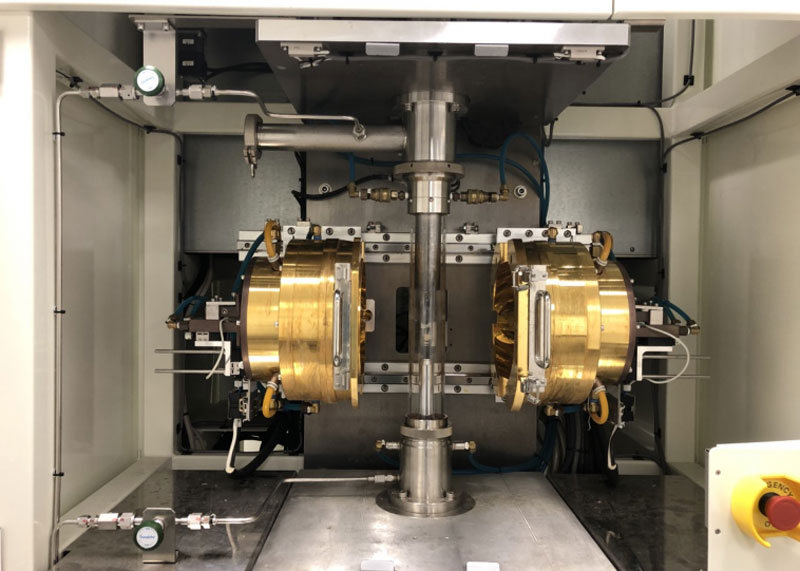
IRG1 applies AI and machine learning to quantum materials discovery, characterization, and model reconstruction. Its work links theory, computation, neutron and X-ray scattering, scanning tunneling microscopy, and quantum materials modeling.
Recent work has focused on validated, experiment-facing workflows that move AI tools closer to spectroscopy, Hamiltonian discovery, automated analysis, and quantum-device design.
Lead: Dr. Adrian Del Maestro
Deputy: Dr. Konstantinos Vogiatzis
Collaborative AI Theme 1
Learning Models from Data
Uses data-driven approaches to learn physical models and extract insight from quantum materials data.
Collaborative AI Theme 2
Automation and Steering
Builds toward automated analysis, experimental steering, and more autonomous measurement workflows.
Collaborative AI Theme 3
Translational AI for Materials
Applies AI methods to materials prediction, quantum chemistry, screening, and experiment-facing tools.
Recent Progress
Publication-linked advances in AI-enabled quantum materials research.
Chiral superconductivity
A quasiparticle-interference fingerprint helped identify chiral superconductivity in an engineered quantum system.
Read the publicationQuantum-accurate helium–benzene potential
Gaussian-process regression connected high-accuracy quantum chemistry with materials prediction.
Read the publicationInterpretable machine learning
Kolmogorov–Arnold network methods supported interpretation of crystal energy landscapes.
Read the publication
IRG2
Advancing Next Generation Alloys and Ceramics for Extremes
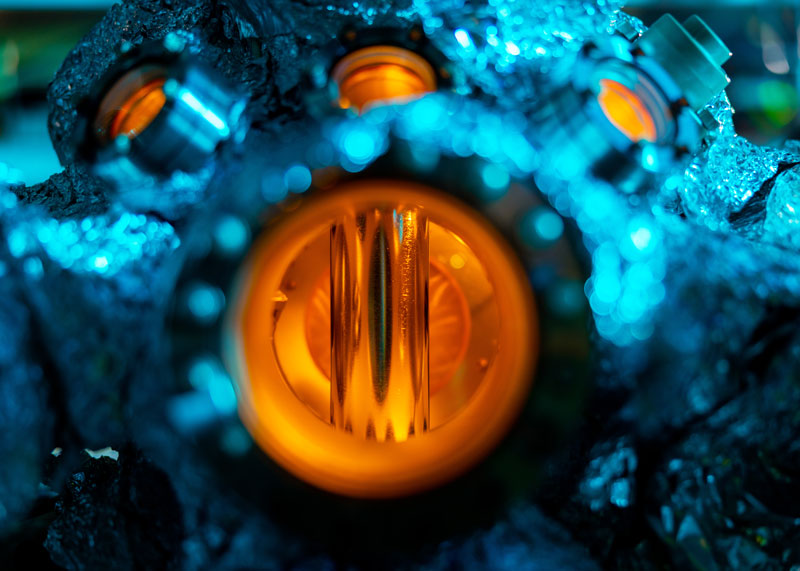
IRG2 develops discovery and characterization workflows for refractory compositionally complex alloys and ceramics designed for coupled extreme environments, including irradiation, high temperature, pressure, and mechanical deformation.
The group connects theory-guided design, high-throughput synthesis, autonomous characterization, modeling, and validation.
Lead: Dr. Steve Zinkle
Deputy: Dr. Katharine Page
Research Area 1
Theory-Guided and High-Throughput Materials Discovery
Uses theory-guided design, machine learning, combinatorial synthesis, and multimodal characterization.
Research Area 2
Multi-scale Structure–Property Relationships
Connects processing, structure, properties, and performance across length scales.
Research Area 3
Controllable Phase Behavior under Extremes
Studies phase stability, defect evolution, and materials response under coupled extreme conditions.
Recent Progress
Publication-linked advances in materials for extreme environments.
Machine-vision nanoindentation
Automation of nanoindentation targeting supported more efficient characterization workflows.
Read the publicationAmorphization resistance
Research on titanate pyrochlores connected compositional complexity with amorphization resistance under swift heavy ion irradiation.
Read the publicationHuman-guided Bayesian optimization
Pareto-optimal experimentation advanced multi-objective Bayesian optimization in scanning probe microscopy.
Read the publication
Connected Research
Integrated experiment–theory–AI discovery workflows
The IRGs connect experiment, theory, machine learning, synthesis, characterization, and computation.
This shared approach supports discovery workflows for quantum materials and materials under extreme conditions while strengthening collaboration across disciplines.